
Solar and cellular shades in Miami, the ones you buy for the heat
Screen fabrics that cut glare and keep the view, honeycomb cells that hold the heat off the glass, and woven wood or sheer where a room needs softening.
- ★ 4.8 111 Google reviews
- Since 2011 in business
- A+ BBB rating, not a BBB Accredited Business
- Top 6 Expertise.com, Miami 2026
- Somfy motorization
Half of Miami’s cooling load comes through the glass
Air conditioning is 28% of the energy consumption of a Florida home, compared to 2% in Maine (U.S. Energy Information Administration, RECS 2020). That difference is all about the climate.
Of that 28%, nearly 30% comes through the windows—the largest single thermal leak in a house (Florida Solar Energy Center, University of Central Florida). A west-facing wall of glass is where your cooling bill gets written.
The sun that hits a standard double-pane window is 76% converted into heat inside the room (U.S. Department of Energy). A solar shade or cellular shade intercepts that conversion at the glass, before the heat spreads into the air you are paying to cool.
A cellular shade can reduce solar heat gain by up to 60% during the cooling season (U.S. Department of Energy). That is not a promise—it depends on the orientation, the sun angle, and the season. But it is why we sell them on south and west-facing glass in Miami.
An open weave, and everything follows from that
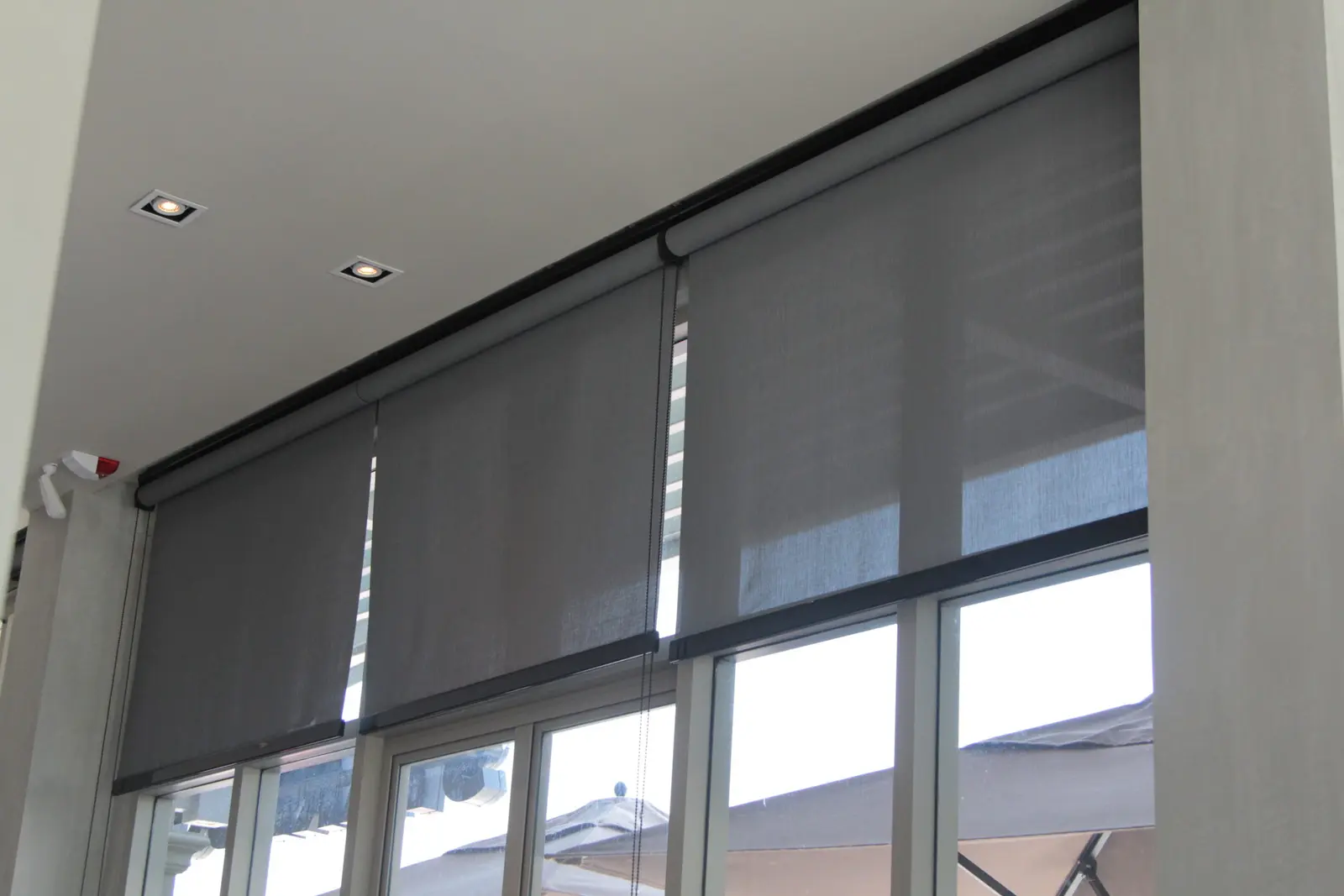
A solar shade is a screen fabric with an open weave. It intercepts the sun before it becomes heat inside the room, takes the glare off a screen, and blocks a good part of the ultraviolet that fades floors, rugs and art. And it does all of it without closing the room: you keep looking out through the weave. In a city built out of glass, it is the most useful thing you can put on a window.
Color matters as much as openness. A dark fabric gives a sharper view out and better glare control; a light fabric bounces more sun back but washes out the view and glows when the sun hits it directly. On a west-facing window we almost always end up dark and low openness.
And the part nobody mentions while selling it: a solar shade works on contrast. During the day you see out and nobody sees in. After dark, with the lights on, it reverses. If that window also needs privacy at night, it wants drapery in front, a zebra shade instead, or a blackout shade behind.
We will not promise you a figure on the power bill, because that depends on your glass, your orientation, your thermostat and your habits. What we will tell you is which fabric moves the needle on your specific window, and why.
Choosing the openness
Openness is the percentage of the weave left open, and on a solar shade it is the decision that changes the result. The Miami rule: the more direct sun the window takes, the lower you go.
| Openness | View out | Glare and heat control | Where it belongs |
|---|---|---|---|
| 1% to 3% | Preserved, darker | Strongest | West and south-facing glass, high floors over water |
| 5% | Good | Balanced | Most living areas |
| 10% and up | Best | Weakest | North-facing glass, shaded exposures, covered terraces |
Cellular, woven wood and sheer
Cellular, also called honeycomb. Rows of honeycomb-shaped pockets that hold a layer of still air against the glass. That trapped air is the insulation, and it is what makes the cellular the strongest thermal shade we sell. Single cell for most rooms, double cell where the heat is the whole problem. The same construction comes in light-filtering or blackout fabric. Ask for the top-down bottom-up version and you can drop the top for daylight while the bottom stays closed, which is the right answer for a ground-floor bathroom or a bedroom facing a walkway. They take the edge off the echo too, which you notice in a condo of tile floors and glass walls.
Woven wood. Bamboo, reed, jute and grasses woven into a shade. This is the texture product: it warms up a room of tile, glass and white walls, which is most of Miami. Unlined it filters the light and shows the weave from both sides; with a privacy or blackout liner it works in a bedroom. We do not put it in a wet bathroom or on an open terrace, because natural fibre and Miami humidity are not friends.
Sheer shades. Two layers of sheer fabric with a fabric vane suspended between them. Tilt the vane to aim the light like a blind, or raise the whole thing to clear the glass like a shade. Horizontal for standard windows, where the light that comes through is diffused and never harsh. Vertical for sliders and wide openings, where it gives you the operation of a vertical blind with the softness of fabric.
Which one for which window
How we actually decide at the measurement. Almost no home is solved with one product on every window.
| The problem | What we would quote |
|---|---|
| Afternoon glare on the TV, west-facing glass | Solar screen at low openness, in a dark color |
| The room is an oven by four in the afternoon | Double cell cellular, or a solar screen with drapery over it |
| Ground floor, people walking past the window | Cellular, top-down bottom-up |
| A bedroom that has to be dark | Blackout cellular, or a blackout roller: see the blackout shades page |
| A wide slider with sun and no privacy | Sheer vertical, or a solar screen paired with drapery |
| Floors, rugs and art are fading | Solar screen at low openness on the exposed windows |
| The room feels cold and hard | Woven wood |
| You want to raise all of them without getting up | Any of the above with Somfy: see motorized shades |
Working with Romina was a pleasure. She and her team measured and installed shades in my 1500 sq ft office of mostly floor to ceiling windows. They were timely and professional.
Frequently asked questions
Do solar shades really cut the heat?
They intercept the sun at the window, before it turns into heat inside the room, and the lower the openness the more of it they stop. A cellular shade does more thermally, because the honeycomb holds a layer of air against the glass, but it closes the view. Which of the two we recommend depends on the orientation of that particular window and on whether you want to keep looking out of it.
What openness should I choose?
1% to 3% for west and south-facing glass and for high floors with glare coming off the water, 5% for most living areas, and 10% or more only where the window is shaded or faces north. The more direct sun the window takes, the lower the openness you want.
Do solar shades give privacy at night?
No. A solar shade works on contrast, so the daytime effect reverses once the lights are on inside. For a window that needs both, we pair the solar shade with drapery, or fit a zebra shade, or a blackout shade if the room also has to be dark.
Are cellular shades worth it in Miami?
On the windows that take direct sun, yes: it is the best-performing shade we sell against heat coming through the glass, and the air pocket also helps with noise. On a shaded, north-facing window the thermal gain is small and a roller or a solar screen is the better buy.
Can woven wood go in a bathroom?
In a powder room with no shower, yes. In a wet bathroom or on an open terrace, no: natural fibres take on the humidity and end up warping and discolouring. There we use a screen fabric or a moisture-tolerant roller instead.
Can any of these be motorized?
Yes, with Somfy, and it has to be decided before we order because the motor is built into the shade. If motorization is a maybe, we quote both versions. Call (786) 361-9747 or book the measurement and we bring the fabric samples to your window.
Book your free in-home measurement
Tell us about your windows and we will call you to set a time. In English o en español.
- Free and with no obligation, across Miami-Dade and Broward.
- We bring the fabric swatches to your actual windows.
- You get a fixed written quote before paying anything.
Prefer to talk? Message us on WhatsApp
or call (786) 361-9747
Mon-Thu 9-5 · Fri 9-4 · sales@miamiwindowtreatments.com